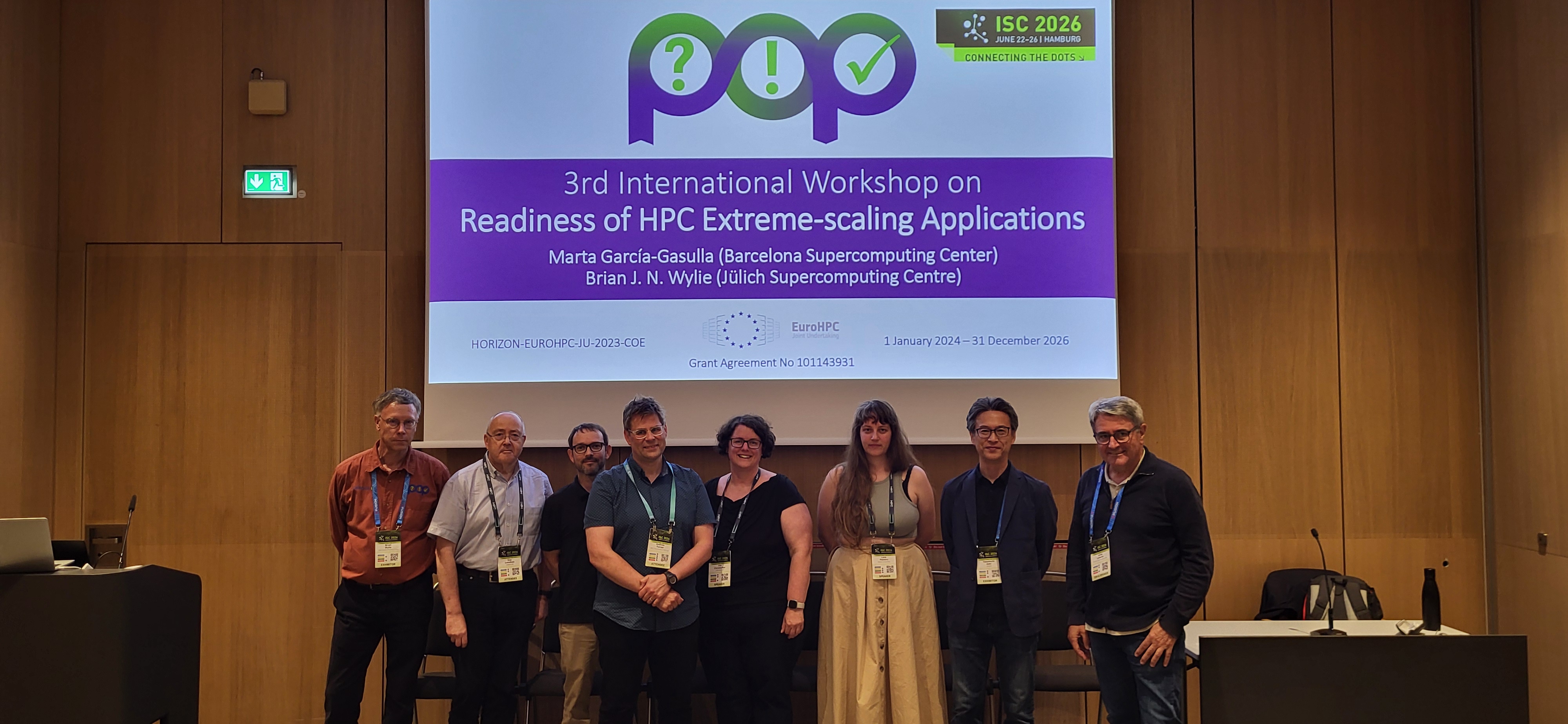
ISC HPC 2026 Workshop
Friday, June 23, 2026
The Top500 list of June 2022 had the first supercomputer with exaFLOPS HPC performance, after many years of international community pursuit of this goal, and several more systems have followed or are expected within the next year. One is the European supercomputer JUPITER, hosted by Jülich Supercomputing Centre and half funded by EuroHPC JU, guaranteeing access primarily for projects led by institutions in Europe. Now is therefore the time for HPC application software to demonstrate its readiness for extreme-scale computer systems composed from large assemblies of a heterogeneous variety of CPU processors and GPU accelerators.
Europe has been preparing HPC applications for this challenge for the last nine years through its Centres of Excellence (CoEs). Since 2015 more than 32 CoE projects have been funded; they aim at greatly extending the scalability of a large variety of HPC codes and improving their execution efficiency and performance.
Performance Optimisation and Productivity (POP) CoE, where both workshop organisers are task leaders, is dedicated to providing free performance assessments to HPC application developers and in particular supports the domain-specific CoEs (as well as the wider HPC community of academic and industry). Insights gathered by POP showed that, although they serve different science fields, many of the challenges that these applications face are common and also the solutions adopted. For this reason, we have organised mini-symposia at two PASC conferences addressing the question: "Are HPC codes ready for exa-scale? An EU HPC Centre of Excellence Point of View''. Representatives from different CoEs shared their experience, via presentations and panels, and very fruitful discussions resulted.
To broaden this activity to a larger community, last year we organised the second edition of this ISC workshop providing a forum to discuss common challenges, ideas, solutions, and opportunities from the point of view of HPC applications developers preparing for exa-scale. ISC is the leading HPC conference in Europe, gathering not only the main HPC vendors and providers but also developers and standardising committees from programming models, compilers, and other system software. However, we still need one of the key players in this ecosystem, the HPC applications! We seek to cover this gap and expand the ISC conference to HPC code developers.
The ISC schedule can be found here.
Organizers:
- Marta García-Gasulla
Researcher and Team Leader, Barcelona Supercomputing Center - Brian J. N. Wylie
Research Scientist, Forschungszentrum Jülich GmbH, Jülich Supercomputing Centre
Workshop agenda:
| 14:00 | Welcome & Introduction to workshop (Garcia & Wylie) (Slides) |
| 14:10 | Keynote “FugakuNEXT application portfolio” (Yasumichi Aoki, RIKEN R-CCS/Japan) (Slides) |
| 14:45 | Paper “Extreme-scale readiness of ParFlow: GPU scaling, architectural portability, and in situ workflows” (Muhammad Fahad, FZJ/D) (Slides) |
| 15:15 | Presentations
|
| 16:00 | Break |
| 16:30 | Presentations (cont.)
|
| 17:15 | Panel discussion (Moderator: Guy Lonsdale, CASTIEL & scapos/D) |
| 17:50 | Conclusion (Garcia & Wylie) |
| 18:00 | Adjourn |
Presentations:
- FugakuNEXT applications and co-design - status and prospects
(Yasumichi Aoki, RIKEN R-CCS/J)Abstract: FugakuNEXT, Japan's next flagship supercomputer for operation around 2030, succeeds Fugaku and is co-developed by RIKEN with Fujitsu and NVIDIA. Unlike the CPU-only Fugaku, it adopts a heterogeneous CPU–GPU architecture targeting 5–10× the effective performance on existing HPC applications and up to 100× for combined simulation-and-AI workloads. This talk reports on the application development and co-design effort behind the system's "Application First" philosophy: the organization of domain sub-working groups, the Early Evaluation Applications spanning fields from life science to fundamental science, and joint profiling and tuning with the vendors. We highlight the challenge of readying a CPU-based ecosystem for a GPU-accelerated, AI-augmented machine, the open continuous-benchmarking (CX) platform built to meet it, and the FY2026 co-design roadmap now in its Detailed Design phase (I).
- Extreme-scale readiness of ParFlow: GPU scaling, architectural portability, and in situ workflows
Muhammad Fahad (FZJ/D)Abstract: Modern supercomputers increasingly combine large GPU counts with complex memory hierarchies, requiring scalable performance, architectural portability, and efficient workflows. This work presents a structured extreme-scale readiness assessment of ParFlow, an open-source GPU-accelerated hydrological model, across these three dimensions.
- Research Data Management for SeisSol using the Geo-INQUIRE Simulation Data Lake
Iris Christadler (LMU/D)Abstract: Dynamic rupture simulations with SeisSol are among the most computationally demanding workflows in Seismology, routinely running on Tier-0 systems. With the increase in computational power, larger parameter studies are now possible. While the scaling behavior of SeisSol is well established, Research Data Management of large-scale parameter studies remains challenging. Expensive HPC results need to be stored and preserved in a FAIR (Findable, Accessible, Interoperable, Reusable) manner. CINECA’s Simulation Data Lake (SDL) is tightly connected to their HPC infrastructure and offers long-term storage of Earth Science Data to the community. The SDL is part of CINECA’s AI Factory. We used the SDL to store a catalog of dynamic rupture simulations and provided a rapid-response workflow as a DT-Geo “digital twin component”. This workflow allows us to detect moderate to large events in the Alto Tiberina (Italy) fault system, download data from the Near-Fault Observatory and search the catalog for the best fitting scenario in minutes. Building on this work, we present our vision for a dedicated NFDI4Earth Lighthouse Use Case project to develop metadata standards, upload wizards, and data tools for the broader earthquake and tsunami simulation community.
- Co-design across four European Centres of Excellence using Domain Specific Benchmarks for EU sovereign technologies
Erwan Raffin (Bull)Abstract: Since November 2025, European has entered the exascale era in high-performance computing (HPC) with JUPITER supercomputer hosted by in Germany at the Jülich Supercomputing Centre. In addition, in response to Europe's strategy on technological sovereignty, EUPEX and EUPILOT projects are developing, respectively, European ARM-based with HBM and RISC-V-based architectures and their associated software stacks. Moreover, thanks to the European Centres of Excellence (CoEs), the flagship applications across a wide range of scientific domains have been prepared and optimized to run efficiently on these systems. This simultaneously fosters co-design activities between technology developers, software stack developers, and scientific HPC application developers. To ease these interactions, a set of Domain Specific Benchmarks (DSBs) has been developed by the CoEs to share relevant full and mini-applications. The benefits of DSBs are multiple: they are free and open-source, provide relevant test cases, and ensure reproducibility through numerical results validation. This talk will present a synthesis of the work carried out on co-design with a focus on EUPEX in the context of four CoEs: ESiWACE (Climate and Weather), ChEESE-2P (Solid Earth and Natural Hazards), MaX (Materials Design) and SPACE (Astrophysics). We will introduce the DSBs developed in these projects, as well as the results obtained, especially when assessing Arm ecosystem and HBM gains compared to DDR. This work will be put in perspective with a wider effort toward scalable, efficient, and performant use of current and future HPC systems.
- Workflow for adding additional software to EESSI
(Lara Peeters, UGhent/B)Abstract: The European Environment of Scientific Software Installation (EESSI, https://www.eessi.io/) is part of the EuroHPC Federation Platform Federated Software Catalog. EESSI provides a uniform catalog and way to interact with software for researchers. Having this resource can mean that they become more independent of the systems that are used for running. When EESSI is available they should have the same software environment wherever they go. In this presentation we go through the steps that are required to get software deployed in EESSI and available on all EuroHPC systems and a number of other systems in and outside Europe.<
- UK researchers and large-scale GPU systems
Andrew Turner (EPCC/UK)Abstract: In this presentation, I will give an overview of progress in initiatives to prepare researcher communities and their software for large-scale GPU-based HPC systems in the UK. This includes preparation for the UK next national supercomputing service, the associated HPC ecosystem provided by the UK National Compute Resources (NCRs) and software projects include the UKRI Living Benchmarks. I will also discuss recent work to understand and reduce emissions from HPC systems in the UK.
- Experiences of an HPC analyst in AI land
(Jesus Labarta, BSC)Abstract: HPC and AI seem to speak different language, however, we should be able to build on HPC performance analysis tools and methodologies to get external assessment of the behaviour of AI applications. Tales from a few explorations are presented.